
Product Search

PPE Knowledge
Safety shoes EN standards overview
Most of our safety shoes comply to EN 20345 and EN 20347 regulations, wear comfortable while providing fair foot protection. Every manufacturing process is under serious inspection in accordance with relevant regulations.
EN345
Maximum requirements for 2nd category safety footwear. The safety shoes in reference must have a minimum crushing resistance of the toe cap of 200 joules. In this rule safety shoes must have:
SB Common protection requirements for all safety footwear.
Stitching and leather resistant to abrasion and tear; the inner textile must absorb the sweat; the shoe must mould itself to the foot; all the materials used for the vamp must favour the transpiration; the sole must be non-slip sole and it must not loose adherence in all the presence of liquid materials, it must be oil resistant, to hydrocarbons and to an exact number of flexions. The SB shoe is not anti-static and it has no shock absorption properties in the heel.
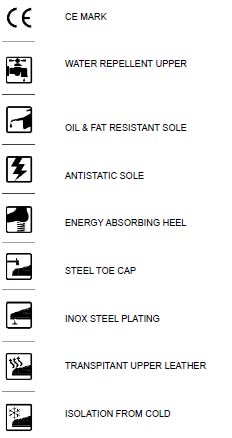
S1 Base protection requirements as SB. Together with these requirements the safety shoes must have anti-static properties, shock absorption in the heel.
S1P Base protection requirements as SB+S1. Together with this requirements the safety shoes must have inox steel plating.
S2 Base protection requirements as SB+S1. Together with this requirements the safety shoes must have water resistant vamp (water repellent WRU).
S3 Base protection requirements as SB+S1+S2. Together with this requirements the safety shoes must have inox steel plating.
S4 Base protection requirements as SB+S1+S2. On rubber or PVC or PVC boots with toe cap, without steel plating.
S5 Base protection requirements as SB+S1+S2. On rubber or PVC boots with toe cap and plating.
ADDITIONAL PROTECTION
The additional protection are indicated on safety shoes together with class protection (examples: S1 HRO, safety shoe with heat resistant sole…).
A Anti-static shoe ( a shoe is antistatic when the electric resistance value is between 100KΩ and 1000MΩ).
C Conductive shoe
HI Insulant shoe till 150℃
CI Insulant cold shoe till -20℃
HRO Heat resistant shoe till 300℃ for a minute
WR Water resistant shoe
ORO Hydrocarbons resistant shoe
ATTENTION: leather water resistant shoes (S2, S3) have a minimum resistance of 60 minutes of penetration; if you need more than 60 minutes you have to fatten the upper; this will bring a higher resistance. Leather shoes (S1) have a resistance to water penetration for 30 minutes. Shoes do not have the same resistance as boots!
EN 346
2nd category safety shoes have the same characteristics of all other safety shoes, the only difference you can find it in the toe cap that has a shock protection up to 100 J. For other characteristics see above mentioned rules and where you will find the letter “S” (=safety) you have to replace it with letter “P” (=protection).
EN 347
Minimum requirements to be protected during all minimum risks (for example manipulation of little objects, industrial cleaning, hospitals,…). EN 347 safety shoes, different from 2nd category safety shoes, do not have toe caps, and they are indentified by the letter “o” (occupational), differing in “01” “02”, “03”, in addition of further requirements. The shoe in object is without toe cap or with a synthetic toe cap, it can be antistatic &/or water resistant. The wearer is responsible to choose the appropriate footwear for the work that he or she does.
Pictograms
|